


John Chadima is an established entrepreneur and community leader in Eastern Iowa, known for owning and operating three successful Firehouse Subs franchise locations that each generated more than $1 million in annual sales. John Chadima coordinated all aspects of these businesses, including financial planning, site design, construction, strategic development, and team leadership. His work emphasized customer-focused operations and strong community engagement, particularly through the Firehouse Subs Public Safety Foundation, which helped donate more than $400,000 in life-saving equipment to local first responders.
Earlier in his career, John Chadima worked in television production and sales support roles and later built a long-standing career in collegiate athletics administration. As a senior associate athletic director at the University of Wisconsin-Madison, he oversaw multiple sports programs, including men’s and women’s golf, and played a key role in major capital facility projects. A lifelong sports enthusiast and former state championship basketball player, his professional background closely intersects with the history and development of American sports culture.
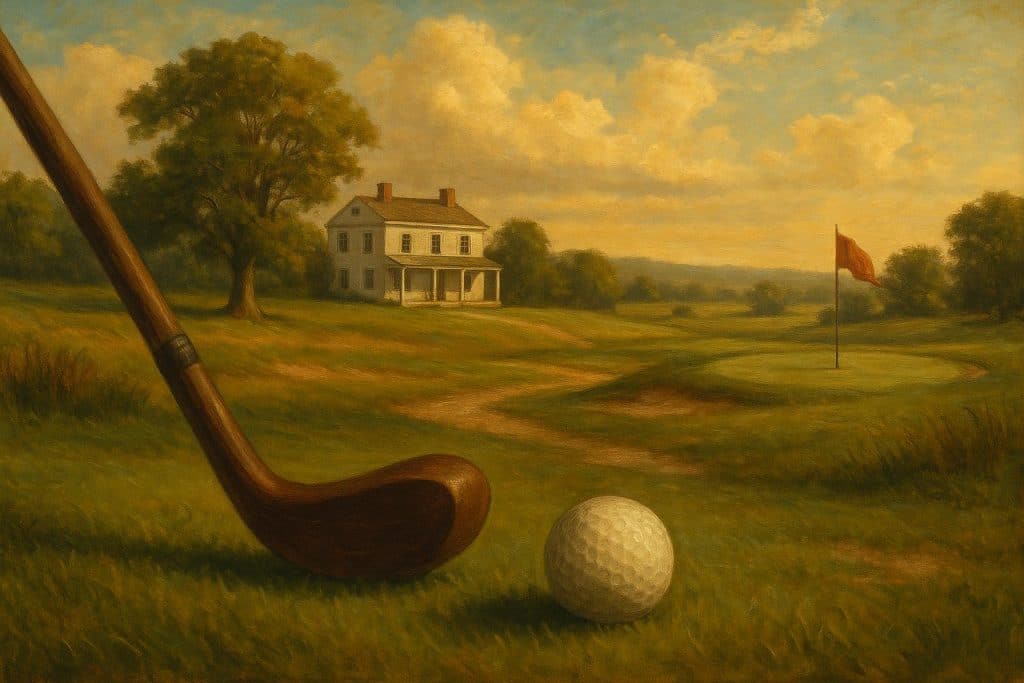
The Early History of Golf in America
Golf is a popular sport in the United States. National Golf Foundation data suggests that nearly 50 million Americans aged 6 and over played golf in 2024, including a record 28.1 million who played on golf courses at least once during the year.
Sports historians are unclear on the exact origins of golf, though the sport’s roots trace back to 15th-century Scotland. The Royal Blackheath opened near London in 1766, the first golf club established outside of Scotland.
The sport landed on American shores during the 18th century, brought over with a large Scottish immigrant population. This included John Reid, who initially played the sport on a three-hole course through an apple orchard. The “Apple Tree Gang” went on to establish the St. Andrew’s Golf Club in Yonkers, New York, one of the clubs that claims the distinction of the nation’s first official golf course.
The South Carolina Golf Club dates back to 1786, though historians know very little about the club’s location or membership. Regardless, South Carolina plays a key role in the early history of golf in America, as Charleston merchant David Deas made the first recorded purchase of golf equipment in the US when he ordered 432 golf balls and 96 clubs from Scotland in 1743. Georgia’s Savannah Golf Club opened in 1794.
The nation’s first 18-hole golf course, the Chicago Golf Club in Wheaton, Illinois, wouldn’t open until 1892. The club was one of the five founding members of the United States Golf Association (USGA) in 1894. The other clubs were The Country Club, a former horse racetrack in Brookline, Massachusetts; the Newport Country Club in Rhode Island; the Shinnecock Hills Golf Club in Southampton, New York; and St. Andrew’s Golf Club in Yonkers.
The association was launched after multiple tournaments claimed to be America’s national amateur championship, and the USGA’s goal was to determine which tournaments were official. In 1916, players formed their own organization, the American Professional Golfers Association, and together the two groups began to establish a national foundation from which the sport could grow.
St. Andrew’s Golf Club and the Newport Golf Club both claimed to host the nation’s amateur golf championship. The USGA responded by formally establishing the US Amateur Championship and the US Open, held during the same week at the Newport Golf Club. The USGA also established the Women’s Amateur Championships.
Charles Blair Macdonald, a notable player and course architect of the time, finished as the runner-up at the Newport and St. Andrew’s tournaments, then went on to win the first US Amateur Championship, defeating Charles E. Sands. He received his trophy from the first USGA president, Theodore Havemeyer. The following day, Horace Rawlins bested an 11-player field to win the first US Open, winning a first-place prize of $150. A week later, Lucy Barnes won the inaugural US Women’s Amateur Championship, the only version of the tournament to use the stroke play format.
A big spotlight on the sport came almost two decades later, when unheralded amateur Francis Ouimet, who had grown up across the street from The Country Club in Brookline and caddied there for several years, surprised the nation by winning the 1913 US Open. The story drew considerable attention and helped popularize the sport, ushering golf into a new era.
About John Chadima
John Chadima is an Eastern Iowa entrepreneur and former collegiate athletics administrator with extensive experience in business operations, sports management, and community engagement. He owned and operated three high-performing Firehouse Subs franchises and previously served as a senior associate athletic director at the University of Wisconsin-Madison, overseeing multiple sports programs, including golf.


Angela Spearman is a journalist at EzineMark who enjoys writing about the latest trending technology and business news.