


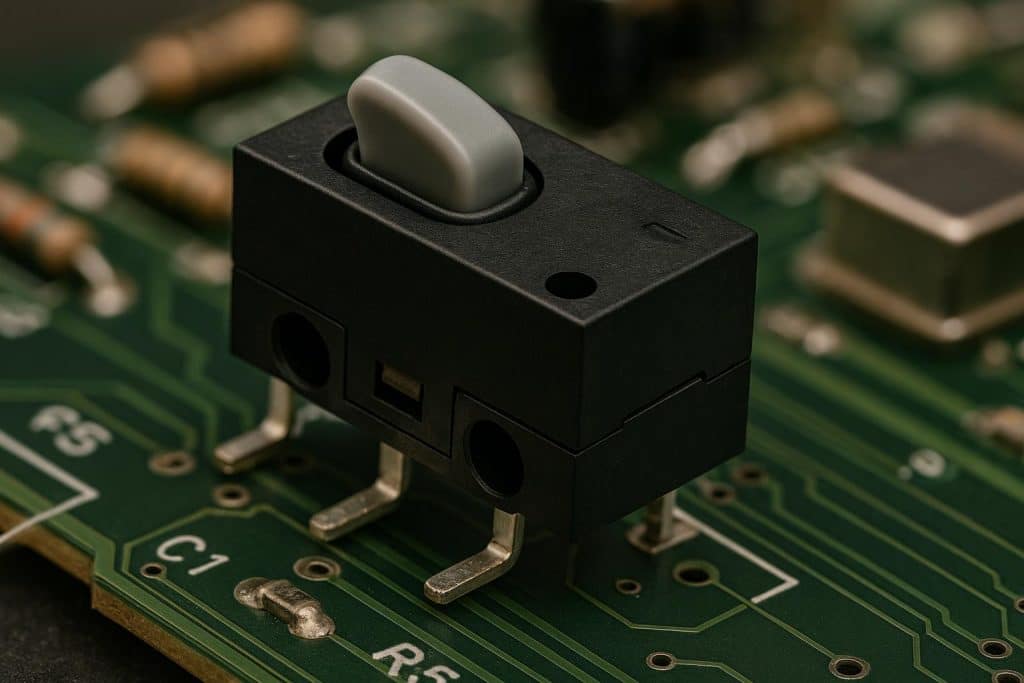
Open almost any appliance, vehicle, or piece of industrial equipment and there is a good chance you will find one: a small plastic-bodied switch with a lever, a roller, or a plunger, producing a distinctive click as it changes state. Most people will never learn its proper name, yet the snap action switch — better known by the generic trademark “microswitch” — has quietly shaped how electromechanical devices have been designed for almost a century. Its story is unusual for a component this humble: a single mechanical idea, devised to solve a problem with heating chicken eggs, ended up underpinning safety systems in aircraft, appliances, vehicles, and factories around the world.
What makes a switch “snap”
Before the snap action mechanism existed, most switches worked the way a basic light switch still does: the speed and feel of the contact closing depended entirely on how fast the operator moved the lever. Move it slowly, and the contacts approach each other gradually, spending a relatively long time barely touching, with poor contact pressure and a tendency to arc, spark, or weld slightly from a slow, weak connection. This was a serious limitation wherever a switch had to be actuated by something other than a deliberate human hand — a thermostat responding to slowly drifting temperature, or a mechanical cam turning at a controlled but unhurried speed.
The snap action design solves this by storing energy in a pre-stressed spring rather than relying on the actuator to directly move the contacts. As an Electronic Design retrospective on the technology describes it, the original mechanism was built so that the plunger’s very short travel stored energy in a spring, and that stored energy was released to transfer the moveable contact with a positive, instantaneous snap, regardless of how slowly the plunger itself was being pushed. The mechanism also exhibits hysteresis, meaning a small reversal of the actuator is not enough to flip the switch back; a meaningful movement in the opposite direction is required, and together these two properties guarantee a clean, fast, repeatable transition every time, however the switch is actuated. It is a beautifully simple piece of physics: decouple the speed of the electrical transition from the speed of the mechanical input, and a whole category of reliability problems disappears.
Born to keep chickens warm
The mechanism’s origin is almost comically mundane. In 1932, Burgess Laboratories of Madison, Wisconsin, took on a contract to build ten thousand electric chicken brooders, and needed a thermostatic switch capable of holding stable, repeatable temperature control — something the switches available at the time could not reliably do. Philip K. McGall, a mechanic at the company, was tasked with developing a new switch and invented the first precision snap-action basic switch to meet the close-tolerance requirements of the brooder equipment. The design was patented and proved so effective that, as one industry retrospective notes, its underlying tipping-point principle is still the basis of most precision snap-acting switches built today.
The new switch did not stay confined to poultry farming for long. It quickly found its way into Rock-Ola jukeboxes and other electromechanical products of the rapidly growing consumer electronics industry of the 1930s, and the business built around it eventually became its own company. Honeywell formally introduced the Micro Switch brand in 1937, and it quickly became known for quality and reliability, before Honeywell Sensing and Control acquired the company and the Micro Switch trademark outright in 1950. The name has since become so closely associated with the technology that, much like “thermos” or “zipper,” it is now used generically for any miniature snap-action switch regardless of manufacturer.
From wartime instrumentation to the household
The Second World War gave the snap action switch its first taste of mission-critical duty. Through the 1940s, the switches were used in military applications including bombsights and navigation equipment, environments that demanded exactly the kind of fast, repeatable, vibration-tolerant contact transition the design was built to provide. One of the switches developed during this period, the V3, was given its name to mark the Allied victory, and remarkably, that same switch design is reportedly still manufactured today on automated production lines at the original Freeport, Illinois facility — a rare example of a component proving so fundamentally sound that eight decades of subsequent engineering have not displaced it.
Peacetime brought the switch into the home. Through the 1950s, snap action switches were built into washing machines and dryers to improve both safety and functionality, giving designers a cheap, reliable way to detect lid and door positions and to interrupt power automatically if a machine was opened mid-cycle. The following decade saw the same mechanism move into heavy industry, as conveyor belts and assembly-line equipment adopted snap action switches through the 1960s for dependable control and sensing. In barely thirty years, a switch invented to keep chicken eggs at a constant temperature had become a standard building block for both domestic safety systems and industrial automation.
The range of devices built around one mechanism
What is striking about the snap action switch is how many physically different products share the identical underlying mechanism, simply by changing the actuator fitted to the front of it.
The most familiar form is the basic switch: a compact, sealed body with a small pin or button that requires only a light, short travel to actuate, used wherever a designer needs simple, reliable presence or position detection at minimal cost. Fit that same body with a hinged lever, and it becomes a lever-actuated switch capable of being tripped by something approaching from an angle rather than head-on. Add a roller to the tip of the lever, and friction and wear are reduced dramatically when the switch is tripped repeatedly by a moving cam, door edge, or mechanical arm — a configuration widely used as a limit switch to mark the end of a permitted range of travel in machinery. Heavier, armoured versions with metal housings and reinforced actuators are built to survive being struck repeatedly by industrial machinery, lift cars, or vehicle components, while sub-miniature and sealed versions shrink the same mechanism down for use inside consumer electronics, keyboards, and handheld devices, sometimes with waterproof boots fitted over the actuator for outdoor or washdown environments.
This modularity is one of the quieter reasons the technology spread so widely. A manufacturer did not need to design a bespoke switching mechanism for every new product; it could choose from a catalogue of standard switch bodies and actuator styles built around one proven internal spring mechanism, and rely on decades of accumulated reliability data rather than reinventing the contact system from scratch.
Where snap action switches are found today
The breadth of applications for this single mechanism is genuinely unusual for an electromechanical component.
In the home, snap action switches sit behind some of the most safety-significant functions in everyday appliances. A microwave oven typically relies on three or four separate switches on its door mechanism, with at least one configured specifically to cut power the instant the door is opened, protecting the user from exposure to microwave radiation. The same family of switch turns on a refrigerator’s interior light when the door opens, confirms that a washing machine lid or door is fully closed before a spin cycle can begin, selects modes on a rice cooker, and provides dry-burn protection in a water heater by sensing fluid or float position.
In vehicles, snap action switches detect whether doors, the hood, or the trunk are fully closed, trigger brake lights, mark the limits of travel for power windows and seats, and sense seatbelt engagement, with automotive applications consistently cited as one of the largest modern markets for limit-switch-style snap action devices. In industrial settings, the same mechanism marks the end-of-travel position for robotic arms, confirms workpiece placement on automated production lines, prevents mechanical components from over-travelling, and forms the basis of machine-guard safety interlocks that physically prevent equipment from starting unless a protective cover or door is fully closed and locked. Lifts use armoured snap action switches to confirm that a car has arrived precisely at floor level before the doors are permitted to open. Vending machines use them to register coin drops, photocopiers and printers use them to detect paper jams and cover positions, and security systems use them to sense whether a door or window has been opened. The mechanism even appears in consumer electronics far removed from its industrial roots, providing the tactile click underneath computer mouse buttons, certain keyboard switches, and game controller triggers, and timing the precise moment a camera shutter fires. Medical equipment uses sealed versions for patient monitoring and diagnostic control where contamination resistance and long-term reliability both matter, and aviation control circuits have used them in applications critical enough that early patent literature specifically discusses the risk of an operator misjudging a circuit’s state if the switch’s characteristic return click is ever absent or muffled — a small but telling sign of how seriously failure modes in this component have historically been taken.
How a simple mechanism changed what devices could do
The snap action switch’s real significance is not the mechanism itself but what it allowed designers to stop worrying about. Before it existed, any switch actuated by something other than a deliberate, fast human hand — a thermostat, a slow-turning cam, a door easing shut under its own weight — was a potential source of arcing, contact welding, and unreliable operation. By guaranteeing a fast, full-pressure contact transition regardless of actuation speed, the snap action mechanism made it practical to automate functions that had previously needed a person to operate a switch directly, or had needed expensive, bespoke switching hardware to manage gentle or variable-speed inputs.
This had a direct and outsized effect on consumer safety engineering. Devices that introduced genuinely dangerous failure modes into the home — a spinning washing machine drum, a microwave oven capable of leaking radiation through an open door, a power lawn mower blade engaged by a clutch — could only be sold to the public once their designers had a switching technology cheap and reliable enough to guarantee, over millions of operating cycles and years of use, that an interlock would actually cut power when it was supposed to. Riding lawn mowers, for instance, commonly use a seat-presence interlock switch to cut the blade clutch the moment the operator leaves the seat, a safety function that depends entirely on the switch being trustworthy enough that the manufacturer is willing to certify the whole machine against it. The snap action switch’s documented durability — commonly rated above one million operating cycles, and up to ten million for heavy-duty industrial variants — gave manufacturers the statistical confidence to build entire safety cases around a component costing only a few cents.
The same reliability also underwrote the first wave of industrial automation. Long before digital position sensors, machine vision, or programmable logic controllers became affordable, a mechanical limit switch was often the only practical way to tell a machine where a moving part was. Conveyor systems, packaging lines, and early robotics relied on arrays of snap action switches tripped by cams, dogs, and moving fixtures to sequence operations automatically, and Honeywell’s own historical materials describe the Micro Switch as one of the major contributing factors behind broader gains in industrial productivity during the decades it spread through factory floors. In that sense, the component did not just appear alongside the growth of mass automation — it was one of the enabling technologies that made early automation economically and technically viable, well before electronics caught up.
Standardisation reinforced this effect. Because Micro Switch’s original basic-switch footprint became a de facto industry reference, other manufacturers built compatible alternatives, and switch selection became a matter of picking a standard part from a catalogue rather than commissioning custom tooling. That turned the snap action switch into a true commodity component: cheap enough to use liberally, standard enough to source from multiple suppliers, and proven enough that a designer rarely needed to test the underlying mechanism itself, only how it had been packaged for a particular job. This is precisely the kind of component-level maturity that allows industries to focus their engineering effort higher up the system, on the appliance, vehicle, or machine as a whole, rather than on reinventing basic switching technology for every new product.
Still relevant in a digital age
It would be reasonable to assume that a century-old mechanical switch has been rendered obsolete by solid-state sensors, optical encoders, and capacitive touch technology, yet snap action switches remain in continuous, high-volume production by manufacturers such as Schaltbau. Their appeal persists for the same reasons that made them successful in 1932: they are inexpensive, require no power to hold a state, tolerate dirt, vibration, and rough handling far better than many electronic alternatives, and provide a positive physical and often audible confirmation of actuation that purely electronic sensing cannot always match. Schaltbau snap action switches, or those made to a similar high quality specification, remain the default choice for endstops in 3D printers and CNC machines, for safety interlocks where a regulator wants a switch with a verifiably “positive opening” action rather than a software-mediated one, and for any application where a designer needs absolute confidence that a mechanical event — a door closing, a lever reaching its limit, a guard locking into place — has produced an unambiguous, reliably timed electrical signal.
Few components illustrate so clearly how a single, well-conceived piece of mechanical physics can ripple outward across an entire century of product design. The chicken-brooder switch of 1932 did not just solve one farmer’s temperature-control problem; it gave generations of engineers a dependable, low-cost answer to one of the oldest questions in electromechanical design — how to know, with certainty, the moment something has happened — and that answer still sits quietly inside an extraordinary number of the devices we use every day.


Angela Spearman is a journalist at EzineMark who enjoys writing about the latest trending technology and business news.