


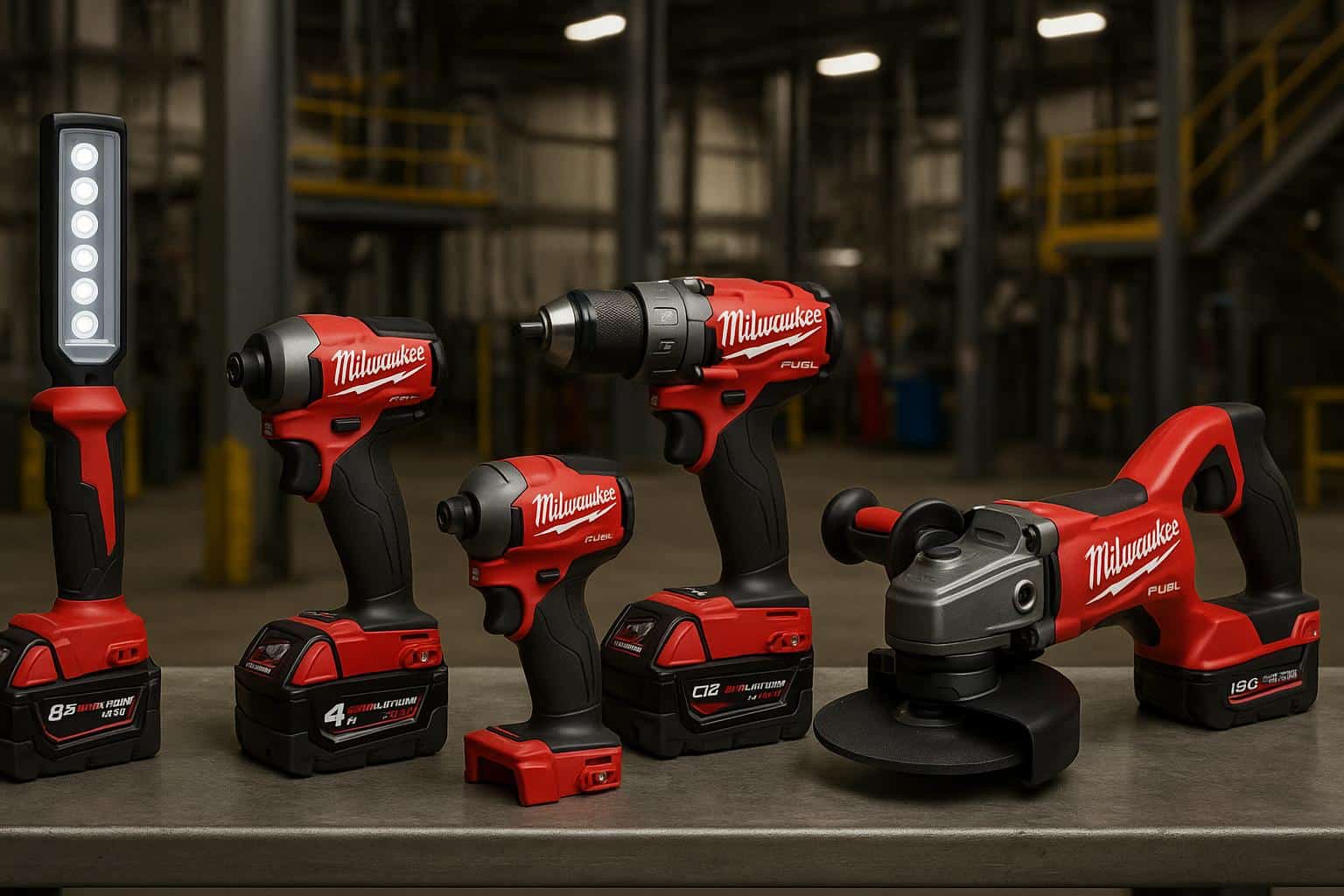
From power generation plants and food processing facilities to manufacturing floors and water treatment works, Milwaukee Tool has become the brand that industrial maintenance professionals reach for when downtime is not an option.
Introduction: Built for the Demands of Industrial Maintenance
Industrial maintenance is one of the most demanding environments any tool can face. Unlike construction work, where a tool might be used intensively for a few months before moving to a new site, industrial maintenance tools are expected to perform reliably day after day, year after year, in environments that combine physical abuse with chemical exposure, temperature extremes, vibration, and the ever-present pressure of keeping critical plant and machinery running.
The maintenance engineer who needs to replace a motor coupling on a production line at two in the morning does not want to be thinking about whether their tools are up to the job. They need tools that start every time, deliver consistent power, and hold up to the kind of continuous, intensive use that industrial environments impose. They need tools that can be trusted absolutely — because in industrial maintenance, the cost of a tool failure is not merely inconvenience, it is production downtime that can translate directly into significant financial loss.
Milwaukee Tool has built its reputation in exactly this environment. Originally founded in 1924 and now operating as a subsidiary of Techtronic Industries, Milwaukee has become one of the most respected names in professional and industrial tooling worldwide. Understanding why — and understanding which specific Milwaukee tools are most valued by industrial maintenance teams — is the purpose of this article.
What Makes Milwaukee Unique: The Engineering Philosophy
Before examining specific products, it is worth understanding the principles and investments that underpin Milwaukee Tool’s position in the industrial market. Several factors distinguish Milwaukee from competitors and explain the brand’s particular appeal to industrial maintenance professionals.
POWERSTATE Brushless Motor Technology
The shift from brushed to brushless motor technology is one of the most significant advances in power tool engineering of the past two decades. Milwaukee’s POWERSTATE brushless motors represent the company’s own developed and refined approach to brushless design, and the advantages they deliver are directly relevant to industrial maintenance use.
In a brushed motor, carbon brushes maintain electrical contact with a rotating commutator. The friction this generates limits efficiency, creates heat, produces carbon dust, and causes progressive wear that eventually requires the motor to be replaced or the brushes to be renewed. In the brushless motor used in Milwaukee’s POWERSTATE system, there are no brushes: the motor is controlled electronically, with the commutation function performed by sensors and control electronics rather than physical contacts.
The practical results for industrial maintenance are significant. POWERSTATE motors run cooler, which extends both motor life and the life of the battery pack under sustained load. They deliver more torque per unit of battery capacity, extending the work that can be done on a charge. They require no brush replacement and suffer no brush-related wear. And they can be controlled more precisely by the tool’s electronics, enabling features like active feedback control under load.
For a maintenance team that relies on their tools in critical applications, the extended tool life and reduced maintenance requirement of brushless technology translate directly into lower total cost of ownership and greater operational reliability.
REDLINK PLUS Intelligence
Milwaukee’s REDLINK PLUS system is the integrated electronics platform that links the tool, the battery, and the charger into a managed system. The intelligence embedded in this system performs several functions that are directly relevant to industrial use.
Overload protection monitors motor current and temperature, and intervenes before either reaches a level that would cause permanent damage. In industrial maintenance, where tools are often being used at the limits of their capability — breaking seized fasteners, drilling into corroded steelwork, grinding weld seams — this kind of protection prevents tool damage without requiring the operator to monitor load conditions constantly.
Battery protection functions monitor cell voltage, temperature, and current during both use and charging, preventing the over-discharge, over-charge, and thermal events that degrade lithium-ion battery life. A battery pack that has been properly managed by REDLINK PLUS throughout its life will deliver significantly more total charge cycles than one that has been operated without electronic protection.
The system also enables the tool to communicate with Milwaukee’s ONE-KEY platform — an asset management and tool customisation system that is increasingly relevant to larger industrial maintenance operations.
ONE-KEY: Digital Tool Management
ONE-KEY is Milwaukee’s digital platform for tool management, customisation, and asset tracking. For industrial maintenance teams managing large inventories of high-value tools across complex facilities, the capabilities ONE-KEY provides represent a genuine operational advance.
Tool customisation through ONE-KEY allows parameters such as maximum torque, speed settings, and operational modes to be adjusted for specific applications. A maintenance team can configure their impact wrenches for specific fastener torque requirements, or limit drill speeds for use in specific materials, ensuring consistent results and reducing the risk of fastener or component damage through incorrect tool settings.
Asset tracking through ONE-KEY records tool usage, location history, and service intervals, supporting the kind of systematic tool management that industrial maintenance operations require. The ability to identify when a tool was last serviced, how many hours it has accumulated, and where it was last used is directly relevant to planned maintenance and tool accountability programmes.
The M18 FUEL Platform: The Industrial Maintenance Backbone
Milwaukee’s M18 FUEL platform — 18-volt tools using POWERSTATE brushless motors and REDLITHIUM battery technology — is the foundation of most industrial maintenance tool kits. The platform’s combination of power, battery compatibility, and product breadth makes it the most logical standardisation choice for a maintenance team.
The key advantage of platform standardisation is battery interoperability: a fully charged M18 battery can power any tool in the M18 family, from a compact drill to a heavy-duty grinder to a powerful pipe cutter. For a maintenance team responding to a breakdown at midnight, the ability to grab any charged battery from the charger and know it will work in any tool they need is an operational advantage that is easy to underestimate until it is absent.
The Essential Milwaukee Tools for Industrial Maintenance
1. Milwaukee M18 FUEL High Torque Impact Wrench
The impact wrench is arguably the single most important tool in an industrial maintenance kit, and Milwaukee’s M18 FUEL High Torque variants — particularly the half-inch and three-quarter-inch drive versions — are among the most capable cordless impact tools available.
Industrial maintenance involves working on flanged pipework, machinery mountings, motor feet, pump bases, conveyor frames, and structural steelwork — all fastened with bolts that may have been in place for years, in the presence of corrosion, thermal expansion cycling, and vibration that can seize fasteners to levels that challenge even powerful tools.
The M18 FUEL Half-Inch High Torque Impact Wrench delivers up to 1,400 foot-pounds of nut-busting torque — a figure that places it ahead of many pneumatic tools and represents a genuine capability step change compared to earlier cordless impact technology. The ability to bring this level of torque to a fastener anywhere in a facility, without running air lines or locating a compressor, is enormously valuable in industrial maintenance.
The four-mode DRIVE CONTROL system allows the tool to be set for specific applications: full power for maximum nut-busting, controlled torque modes for production work where over-tightening must be avoided, and a self-tapping screw mode that prevents screw damage during installation. This versatility means one tool can handle the full range of fastening tasks a maintenance engineer encounters.
The three-quarter-inch drive version adds further capability for the heaviest fastener work — large-diameter flange bolts, structural connections, and industrial machinery mountings — where even the half-inch tool may reach its limits.
2. Milwaukee M18 FUEL Drill/Driver and Hammer Drill
The cordless drill/driver is the universal tool of any maintenance kit, used for everything from mounting cable trays to assembling replacement components, drilling pilot holes, driving screws into panels and enclosures, and a hundred other daily tasks.
Milwaukee’s M18 FUEL Drill/Driver stands out in an industrial context for several reasons. The all-metal chuck provides the secure bit retention that industrial use demands, eliminating the risk of bit slippage under load that can damage workpieces and cause injury. The two-speed gearbox provides genuine flexibility — low speed for high-torque driving, high speed for efficient drilling — with electronic speed control that allows the operator to match the output to the task.
The companion M18 FUEL Hammer Drill adds percussive action for drilling into masonry, concrete, and brick — essential for maintenance work involving cable routing, bracket installation, and equipment mounting in facilities with concrete structures. The ability to switch instantly between rotary and hammer modes without changing tools saves significant time across the course of a working shift.
The POWERSTATE motor in both tools delivers a combination of speed, torque, and runtime that genuinely challenges corded competition, while the cordless format eliminates the trailing cables that are both a safety hazard and a practical inconvenience in busy industrial environments.
3. Milwaukee M18 FUEL SDS Plus and SDS Max Rotary Hammers
For maintenance work involving larger holes in concrete — conduit penetrations, anchor bolt installations, machinery base fixings — the rotary hammer drill provides the impact energy needed to work efficiently in hard materials without the strain and time penalty of using a conventional hammer drill beyond its design limits.
Milwaukee’s M18 FUEL SDS Plus Rotary Hammer is designed for holes up to approximately 28mm in concrete, covering the range needed for most industrial maintenance anchor and penetration work. The combination of a powerful POWERSTATE motor with an electro-pneumatic hammering mechanism delivers impact energy comparable to corded rotary hammers in a cordless package that can be used anywhere in a facility without power access.
For the heaviest work — large conduit penetrations, structural anchor installations, and equipment base work requiring holes above 28mm — the M18 FUEL SDS Max Rotary Hammer steps up with significantly greater impact energy. The ability to perform this kind of work from battery power, without the limitations of cord length or the logistics of running power to remote locations in large facilities, represents a genuine productivity advance for maintenance teams.
Both tools incorporate active vibration control systems that reduce transmitted vibration to the operator — an important health and safety consideration for maintenance personnel who may be using rotary hammers for extended periods across the course of their working day.
4. Milwaukee M18 FUEL Angle Grinder
No industrial maintenance kit is complete without an angle grinder, and the demands placed on this tool in maintenance work are severe. Cutting rusted bolts, grinding weld seams, preparing surfaces for repair, cutting pipe and section steel to length, removing seized components — these are all tasks that require sustained, heavy-duty grinder performance.
Milwaukee’s M18 FUEL angle grinder range — available in 115mm, 125mm, and 230mm disc sizes — uses POWERSTATE motors that deliver performance matching or exceeding comparable corded tools. The 230mm version in particular delivers the disc speed and sustained power needed for serious cutting and grinding work on structural steel and pipe, without the limitations of cord dependency.
The NO-LOCK paddle switch on Milwaukee’s angle grinders is an important safety feature for industrial use: it requires continuous deliberate grip pressure to maintain operation and cuts power immediately when the tool is released, preventing the tool from running uncontrolled if dropped or released unexpectedly. The FIXTEC guard system allows rapid, tool-free guard repositioning, supporting efficient work across varying cutting and grinding orientations.
POWERSTATE motor protection prevents the over-loading that is endemic in grinder use — operators naturally push grinders hard, and without electronic protection, the sustained high-current operation that results can cause premature motor failure. REDLINK PLUS detects and manages these conditions, protecting both the tool and the battery.
5. Milwaukee M18 FUEL Reciprocating Saw
The reciprocating saw — sometimes known by the Milwaukee trade name SAWZALL — is an indispensable tool in industrial maintenance for its ability to cut through almost any material in difficult access conditions. Cutting out corroded pipe sections, removing seized bearing housings, cutting cable runs, demolishing sections of ductwork, and accessing components behind panels — these are all applications where the reciprocating saw’s ability to reach where no other cutting tool can makes it irreplaceable.
Milwaukee’s M18 FUEL Reciprocating Saw delivers the combination of stroke length, strokes per minute, and sustained power that heavy industrial cutting demands. The variable speed trigger gives the operator control over cutting rate, important when working in materials that require careful controlled cutting to avoid damaging adjacent components. The tool-free blade change mechanism allows rapid blade swaps when moving between materials — from bi-metal blades for pipe and section to carbide-tipped blades for abrasive materials — without requiring additional tools.
The shoe adjustment range on Milwaukee’s reciprocating saws is significant for industrial use: a longer shoe engagement distributes blade wear more evenly and extends blade life, while the ability to position the shoe at different depths allows the cutting point to be adjusted relative to tight-clearance obstructions.
6. Milwaukee M18 FUEL Circular Saw
While perhaps less prominent in industrial maintenance than in construction, the circular saw earns its place in any comprehensive maintenance tool kit through its ability to cut sheet materials, timber for temporary structures and platforms, and composite panel materials accurately and efficiently.
Milwaukee’s M18 FUEL Circular Saw delivers blade speeds and cut depth that match corded tools in most practical applications, with POWERSTATE motor protection preventing the stalling under load that characterises underpowered cordless circular saws. The magnesium construction of the shoe plate reduces weight without sacrificing the rigidity needed for accurate guided cuts.
For maintenance teams involved in fabrication work — building replacement guards, constructing storage solutions, or creating temporary access structures — the ability to make accurate sheet and timber cuts from battery power is a genuine asset.
7. Milwaukee M12 FUEL and M18 FUEL Multi-Tools
The oscillating multi-tool occupies a unique position in the maintenance toolkit: it is the specialist’s choice for precise cutting in confined spaces where no other tool can work effectively. Cutting flush with a surface, cutting into grout lines, precise removal of sealant, trimming installed pipework, cutting through material in spaces too confined for any saw — these are applications that the oscillating multi-tool handles when no other tool can.
Milwaukee’s M12 FUEL Multi-Tool is a compact instrument that brings genuine professional cutting performance to the smallest access spaces, while the M18 FUEL version provides more sustained performance for heavier cutting work. The FIXTEC blade change system on both tools allows accessory changes without additional tools — important when working in awkward positions.
The breadth of accessory availability for Milwaukee multi-tools is a significant practical advantage: cut-off blades, saw blades for various materials, sanding pads, scraping accessories, and specialist attachments are all available, making a single tool adaptable to a very wide range of precise maintenance tasks.
8. Milwaukee M18 FUEL Compact Bandsaw
The portable bandsaw is one of the most useful — and frequently overlooked — tools in industrial maintenance, and Milwaukee’s M18 FUEL Compact Bandsaw is one of the finest portable cutting tools available at any price point.
For maintenance teams that regularly cut conduit, cable tray, threaded rod, structural sections, pipe, and bar stock, the compact bandsaw delivers results that are simply not achievable with reciprocating saws, angle grinders, or hand tools. The cut is straight, accurate, and burr-free — important when pipe ends must be accurately finished for re-joining, or when cut lengths must be precise for structural work. The cutting action is also much quieter than grinding, safer than cutting discs, and produces no sparks — an important consideration in industrial environments with flammable or explosive atmosphere considerations.
The compact format of Milwaukee’s bandsaw allows it to be used in relatively confined spaces and carried easily between work locations, while the 64.5mm cutting capacity covers the full range of conduit, pipe, and section sizes encountered in most industrial maintenance work. The variable speed control adjusts blade speed for different materials, extending blade life and improving cut quality across the full range of applications.
9. Milwaukee M18 FUEL Surge Hydraulic Driver
The hydraulic impacting mechanism in the Milwaukee M18 FUEL Surge represents a genuinely different engineering approach to power driving, and its relevance to industrial maintenance is significant in specific applications.
Unlike a conventional impact driver that delivers its driving torque through mechanical impacts — with the characteristic loud rattling noise that accompanies this — the Surge uses a hydraulic cell to store and release energy, delivering a smoother torque output with dramatically reduced noise. The noise reduction is not trivial: in many industrial environments, noise exposure is a regulated health and safety concern, and the use of pneumatic impact tools can contribute significantly to cumulative noise exposure. The Surge delivers comparable driving performance to a standard impact driver at a fraction of the noise level.
For maintenance work in sensitive areas — near operators, in environments where noise is regulated, or in facilities where social responsibility to workers is taken seriously — the Surge provides an impact driver solution that delivers professional performance without the noise penalty.
10. Milwaukee M18 and M12 Lighting Range
In industrial maintenance, working in good light is not a luxury — it is a safety and quality requirement. Electrical panels, motor terminal boxes, pump casings, and the interiors of machinery enclosures are typically poorly lit, and the quality of diagnostic and repair work is directly related to the quality of illumination available.
Milwaukee’s lighting range — including area lights, work lights, floodlights, and inspection lights across both the M12 and M18 platforms — provides maintenance teams with professional illumination that shares the same battery platform as their other tools. The ability to deploy a powerful, battery-powered area light at any work location — without running extension leads or relying on fixed facility lighting — is a genuine operational advantage.
The M18 RADIUS Compact Site Light deserves particular mention for industrial maintenance: its 360-degree illumination provides effective area lighting in a compact, easily positioned format that can be set up quickly and moved as work progresses. The magnetic base available on several Milwaukee light models adds further flexibility, allowing the light to be mounted on steelwork, machinery frames, or cabinet doors to illuminate a specific work area hands-free.
Milwaukee’s inspection lights — compact, flexible-neck instruments designed for close-up work in confined spaces — are indispensable for work inside electrical panels, motor control centres, and machinery enclosures where task lighting is critical.
11. Milwaukee M18 FUEL Pipe Threader
For maintenance teams working with threaded pipework — common in compressed air systems, hydraulic installations, steam and hot water systems, and process pipework — the ability to cut accurate threads on-site is enormously valuable. The alternative, relying on pre-threaded pipe sections or workshop threading machines, limits flexibility and slows response times when urgent repairs are needed.
Milwaukee’s M18 FUEL Pipe Threader delivers the capability of a bench-mounted threading machine in a portable, battery-powered format that can be deployed anywhere in a facility. It covers pipe sizes from half-inch to two inches NPT — the range covering the vast majority of industrial pipework applications — and delivers thread quality that meets the standards required for pressure-containing joints in all common industrial systems.
The ability to cut a thread at the point of work, rather than carrying cut pipe sections back to a workshop threading machine, can transform response times on piping repairs and reduce the material waste associated with pre-cut-and-thread approaches.
12. Milwaukee M18 FUEL Cordless Torque Wrench
Correct fastener torque is as important in industrial maintenance as it is in automotive work. Equipment mountings, flange connections, structural joints, and electrical terminal connections all have specific torque requirements that must be met to ensure safety, reliability, and compliance with manufacturer specifications.
Milwaukee’s M18 FUEL cordless torque wrench range brings electronic torque control to maintenance fastening work, allowing torque values to be set and achieved consistently without the weight and bulk of a large torque wrench or the limitations of click-type instruments in confined spaces. The audible and visual alert when target torque is reached ensures consistent results even in noisy industrial environments.
Milwaukee’s Test and Measurement Range: A Natural Extension
In recent years, Milwaukee has extended its product range to include test and measurement instruments — a logical expansion for a brand serving industrial maintenance professionals.
Milwaukee Voltage Testers and Multimeters
Milwaukee’s electrical test instruments — voltage testers, multimeters, and clamp meters — are designed to the same quality and durability standards as the power tool range, addressing a long-standing frustration among maintenance engineers with the fragility and ergonomic limitations of many traditional test instruments.
The Milwaukee multimeter range offers CAT III and CAT IV safety ratings appropriate for industrial electrical work, with probe storage, lead management, and display visibility designed for workshop rather than laboratory conditions. The robustness of these instruments — capable of surviving drops and exposure to workshop contamination without failure — is directly relevant to industrial maintenance use.
Milwaukee Thermal Imagers
Thermal imaging has become an essential diagnostic tool in industrial maintenance, enabling electrical faults, mechanical bearing failures, insulation defects, and process anomalies to be identified before they result in failure. Milwaukee’s thermal imager range brings professional infrared imaging capability to the maintenance toolkit at price points that make facility-wide deployment practical.
Battery System Management: The Operational Advantage
For a large industrial maintenance team, battery management is an operational discipline in itself. A team operating dozens of M18 FUEL tools across a facility needs a systematic approach to battery charging, rotation, and storage to ensure that batteries are always available when needed.
Milwaukee’s REDLITHIUM battery range — spanning from compact 2.0Ah packs for light-duty work through to REDLITHIUM HIGH OUTPUT 12.0Ah and above for the most demanding sustained-use applications — provides the flexibility to match battery capacity to application requirements. The HIGH OUTPUT packs, using a new cell format with enhanced thermal management, deliver both higher peak power and better sustained performance under the continuous heavy loads characteristic of industrial maintenance work.
The M18 and M12 PACKOUT charging systems integrate with Milwaukee’s PACKOUT modular storage platform, allowing charging to be managed within the same organised storage system that houses tools and accessories. For a maintenance team with a central tool store, this integration provides a rational approach to battery rotation and monitoring.
The PACKOUT System: Organisation for Industrial Professionals
Milwaukee’s PACKOUT modular storage system has become one of the most widely adopted professional tool storage solutions in the industrial market, and its popularity reflects a genuine need that it addresses effectively.
Industrial maintenance requires carrying different sets of tools to different tasks — an electrical fault requires different tools from a mechanical breakdown, which requires different tools from a pipework repair. The PACKOUT system’s modular, stackable, interlocking format allows tool sets to be organised by task, combined for transport, and separated at the work location with a speed and organisation that traditional tool bags and boxes cannot match.
The PACKOUT cases, organisers, and tool bags are built to the same durability standards as Milwaukee’s power tools, with IP65 weather sealing on the cases protecting tools and equipment from the wash-down environments common in food processing and pharmaceutical facilities. The wheeled base units carry substantial loads over uneven surfaces, reducing the physical burden on maintenance personnel who may need to carry comprehensive tool kits across large facilities.
The integration of charging capability into PACKOUT units — through the PACKOUT charging station — creates a self-contained tool management solution that supports systematic battery rotation and ensures tools are always ready for deployment.
Why Industrial Maintenance Teams Standardise on Milwaukee
The decision to standardise a maintenance tool kit on a single platform is significant, and the factors that lead maintenance managers to choose Milwaukee consistently across different industries and applications are worth summarising.
Battery interoperability is the most immediate operational benefit: a single battery type powering the full range of tools eliminates the complexity and cost of managing multiple battery systems and ensures that any charged battery works in any tool.
Tool performance that genuinely matches or exceeds pneumatic and corded alternatives means that the productivity case for cordless tools is not compromised: maintenance engineers can work faster and more freely without accepting any reduction in capability.
Durability and reliability in demanding industrial environments reduces tool replacement costs and, more importantly, eliminates tool failures at critical moments. A Milwaukee tool that has been in daily industrial use for several years and continues to perform reliably represents genuine value, regardless of its initial purchase price.
The breadth of the Milwaukee range means that standardisation does not require compromise: whatever the maintenance task, there is a Milwaukee tool designed for it, built to the same standard as every other tool in the range.
Support and service infrastructure — including authorised service centres, parts availability, and the ONE-KEY digital platform — provides the after-sales support framework that professional industrial users require.
Conclusion: The Industrial Maintenance Professional’s Choice
Milwaukee Tool has earned its position in industrial maintenance tool kits through consistent delivery of what maintenance professionals actually need: tools that are powerful enough to handle the most demanding tasks, reliable enough to be trusted in critical situations, durable enough to justify the investment, and systematically organised into a coherent platform that supports efficient, professional operation.
The tools highlighted in this article — from the M18 FUEL High Torque Impact Wrench to the PACKOUT modular storage system — represent the core of what Milwaukee offers to industrial maintenance teams. Each one addresses a real maintenance need with engineering quality and feature intelligence that reflects genuine understanding of how professional maintenance work is done.
In the industrial maintenance environment, where the consequence of tool failure extends beyond inconvenience to real operational and financial impact, the case for Milwaukee is ultimately straightforward: these are tools that you can depend upon, day after day, in conditions that would overwhelm lesser products. That dependability, consistently delivered over years of professional use, is why Milwaukee has become and remains the benchmark choice for industrial maintenance professionals worldwide.
Milwaukee Tool products are available through professional tool distributors, industrial supply specialists, and electrical wholesalers throughout the United Kingdom and worldwide. The M18 FUEL platform represents the recommended core for industrial maintenance standardisation.

Angela Spearman is a journalist at EzineMark who enjoys writing about the latest trending technology and business news.
